INTRODUCTION
The living room is more than a space; it is the soul of a home, a canvas for personal expression and a testament to one’s appreciation for beauty and permanence. For the discerning homeowner, the choice of flooring is not merely a practical decision but a foundational statement of intent. It sets the stage for every interaction, every piece of art, every moment of repose. Yet, achieving a world-class aesthetic that balances grandeur with warmth, and timelessness with contemporary flair, presents a significant design challenge. Off-the-shelf solutions often fall short, leaving spaces feeling generic rather than genuinely luxurious.
In the realm of high-end interior design, investment is intrinsically linked to enduring value. A meticulously crafted living environment transcends fleeting trends, becoming a permanent asset that elevates daily living and significantly enhances property valuation. This is where the concept of bespoke Italian marble living room flooring ascends from a simple material choice to a strategic investment in artistry and legacy. It represents the pinnacle of premium materials and custom craftsmanship, promising an unparalleled sensory experience.
This comprehensive guide is your portal to understanding and achieving this zenith of interior design. We will explore the philosophy behind bespoke marble, deconstruct its key elements, provide a practical framework for execution, and analyze its tangible value. Our promise is to equip you with the knowledge to envision and collaborate on creating a living room floor that is not just installed, but composed—a singular masterpiece underfoot.
THE ESSENCE OF BESPOKE ITALIAN MARBLE LIVING ROOM FLOORING
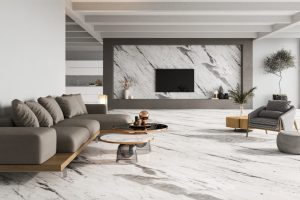
Bespoke Italian marble flooring is defined by its singularity. Unlike standard marble tiles, a bespoke approach treats the entire floor as a continuous work of art. It involves the meticulous selection of raw stone blocks—often Carrara, Statuario, Calacatta Oro, or Portoro—which are then slabbed, book-matched, and laid in a unique pattern specifically engineered for your space. The result is a seamless, flowing surface where the natural veining tells a continuous, dramatic story across the room, with no repetitive tile patterns to break the illusion of a monolithic stone expanse.
The philosophy underpinning this choice is one of Quiet Luxury and profound connection. It moves beyond ostentation to celebrate the raw, authentic beauty forged by nature over millennia. This aligns powerfully with biophilic design principles, creating a tangible link to the earth’s geology. The cool, solid touch, the unique patterning that mirrors landscapes, and the way light dances across crystalline surfaces all serve to ground a space in organic elegance. It is luxury that feels inherent, not applied.
As we look toward 2026 design trends, this approach is not merely persisting but evolving into a leading movement. In an age of digital saturation and mass production, there is a growing hunger for authenticity, craftsmanship, and personalized environments. Bespoke marble answers this call perfectly. Furthermore, its compatibility with smart home integration—such as radiant heating systems seamlessly embedded within—and its role as a neutral yet powerful backdrop for technologically advanced, minimalist interiors cement its status as the future-forward choice for luxury living.
KEY ELEMENTS AND CHARACTERISTICS
The majesty of a bespoke marble floor is realized through several non-negotiable elements, each demanding expert attention.
- The Slab Selection & Book-Matching: The heart of bespoke work lies in choosing consecutive slabs from the same block. Craftsmen then “book-match” them (opening them like the pages of a book) to create symmetrical, mirror-image veining patterns. This technique transforms random beauty into intentional, breathtaking art.
- Precision Cutting & Layout (The “Pavimento”): A master installer, or *terrazziere*, does not simply lay tiles. They create a *pavimento*—a designed floor composition. This involves intricate geometric layouts (herringbone, Versailles pattern), custom borders, or insets of contrasting marbles, all cut with laser precision for hairline joints.
- Architectural Lighting Integration: The floor does not exist in isolation. Recessed architectural lighting, strategically placed coves, or carefully positioned floor lamps are designed to graze the surface, activating the marble’s translucency and making veins glow from within.
- Seamless Finish & Honing: The finish is critically personal. A high-gloss polish offers dramatic reflection and formality. A honed or matte finish provides a soft, velvety texture that is contemporary and understated, reducing slipperiness and hiding micro-scratches more gracefully.
- Structural Integrity & Subfloor Preparation: True luxury is built from the ground up. This requires an absolutely level, reinforced subfloor to prevent any future cracking or movement in the heavy stone—a non-negotiable investment in longevity.
- Artisanal Grouting & Resining: Joints are virtually eliminated or filled with color-matched epoxy resin or minimal grout, ensuring the visual continuity of the stone is paramount. The goal is to see the marble, not the seams that hold it.
- Sustainable Luxury & Sealing: Modern sealing technologies use impregnating agents that protect the stone from within while allowing it to breathe. Choosing quarries with responsible extraction practices adds a layer of sustainable luxury to your project.
DESIGN FRAMEWORK: A STEP-BY-STEP EXECUTION PLAN
Transforming your vision into reality requires a disciplined, professional approach. Follow this framework to ensure a flawless outcome.
- Engage a Specialist Designer or Architect: Your first step is to partner with a professional experienced in natural stone and luxury residential projects. They will translate your aesthetic desires into technically sound plans.
- Comprehensive Space Analysis: Your designer will assess structural load-bearing capacity, existing light sources, spatial flow from adjacent rooms, and the intended use of the space to inform the marble type and layout.
- The Stone Selection Pilgrimage: Visit premium stone yards or work with your designer to view full slabs digitally and physically. Observe how light affects them at different times of day. This is where emotional connection meets practical selection.
- Finalize the “Pavimento” Design: Collaborate on the final layout drawing. This blueprint will detail pattern direction, seam placement, border designs, and integration points with other flooring materials.
- The Technical Specification Package: Your designer will create detailed documents covering subfloor specs (often involving levelling compounds or additional joists), adhesive types, sealing products, and acceptable tolerance levels for installation.
- Vetting and Commissioning Master Installers: The installation team is as crucial as the stone itself. Ensure they have verifiable portfolios of similar bespoke marble projects. Never compromise on craftsmanship at this stage.
- Phased Installation & Protection: The installation will be methodical. Once laid, the floor must be meticulously protected during the rest of the renovation with specialized non-stick coverings to prevent damage from tradespeople.
INVESTMENT & VALUATION: THE COST OF LEGACY
The investment in bespoke Italian marble is substantial but must be viewed through the lenses of artistry, durability, and property enhancement. Costs are multifaceted: the raw material (premium slabs can be 3-5x the cost of standard tiles), the specialized design fees, the master craftsmanship of cutting and installation, and any required structural work.
The return on investment (ROI) for such a project is significant in terms of interior ROI. It fundamentally elevates the property’s market positioning, attracting discerning buyers who recognize and are willing to pay a premium for irreplaceable craftsmanship. It is a permanent improvement that defines the home’s character.
| Cost Component | Investment Range (IDR) | Key Considerations & Impact on Value |
|---|---|---|
| Premium Italian Marble Slabs | Rp 3.500.000 – Rp 12.000.000 per square meter | Varies by rarity (e.g., Calacatta Oro vs. Carrara). The unique veining becomes a selling feature. |
| Specialist Design & Project Management Fees | Rp 75.000.000 – Rp 300.000.000+ | Ensures technical perfection and aesthetic cohesion; prevents costly errors. |
| Master Installation & Craftsmanship | Rp 1.200.000 – Rp 3.500.000 per square meter | The single most critical factor for longevity and visual success. Never economize here. |
| Subfloor Preparation & Ancillary Materials | Rp 500.000 – Rp 1.800.000 per square meter | Unseen but foundational; guarantees against future cracking or failure. |
| Estimated Value Add to Property | High ROI / Differentiator | While variable by market, it creates a unique “wow” factor that can significantly exceed the investment cost at resale by elevating the entire property tier. |
ICONIC DESIGN EXAMPLES: CASE STUDIES IN MARBLE MASTERY
The Jakarta Skyline Penthouse: A 400-square-meter residence featured a flowing field of honed Statuario Venato. The designer used book-matched slabs across the great room to create a single, dramatic vein that directed sightlines toward floor-to-ceiling windows overlooking the city. Radiant heating was embedded throughout for tropical comfort.
“The marble was our anchor,” noted lead designer Elena Rossi. “Its quiet drama allowed us to be bold with minimalist, sculptural furniture without competing for attention. The client didn’t just get a floor; they got a geological centerpiece.” Specific data: Slabs were 30mm thick for added presence, with joints under 1mm filled with color-matched epoxy.
The Ubud Cliffside Villa: Embracing biophilic design, this project used locally sourced Verde Alpi marble with deep green and white veins echoing the surrounding jungle. The layout was a custom geometric pattern that extended seamlessly from the interior living area out to the covered terrace, blurring the boundary between inside and out.
“We treated the indoor and outdoor as one canvas,” explained architect Ken Williams. “The marble’s durability and aesthetic continuity were key. At dusk, with integrated perimeter lighting grazing the surface, the floor looks like a forest stream captured in stone.”
COMPARISON TABLE: BESPOKE MARBLE VS. LUXURY ALTERNATIVES
| Feature | Option A (Bespoke Italian Marble) | Option B (Designer Ready Large-Format Porcelain) | Option C (Smart Luxury Engineered Terrazzo) |
|---|---|---|---|
| Initial Investment | Rp 5.200.000 – Rp 17.300.000+/m² (all-in) | Rp 1.800.000 – Rp 4.500.000/m² (all-in) | Rp 3.500.000 – Rp 8.000.000/m² (all-in) |
| Aesthetic & Uniqueness | 100% unique natural art; seamless, monolithic appearance; timeless prestige. | High-quality replication of stone/wood; consistent patterning; excellent for minimalist looks. | Custom blend of aggregates/glass; modern, graphic appeal; fully customizable color palettes. |
| Durability & Maintenance | Extremely durable for centuries but porous; requires professional sealing; can etch from acids. | Extremely hard, scratch/stain/acid resistant; virtually zero maintenance; no sealing needed. | Very durable and non-porous; low maintenance; highly resistant to stains and chemicals. |
| Comfort & Integration | Naturally cool; ideal for integrating invisible radiant heating; adds thermal mass. | Can feel cold; compatible with radiant heat; thinner profile may require less subfloor adjustment. | Can integrate radiant heat; often poured in place allowing for completely seamless transitions. |
| Resale Value Impact | Highest perceived value; major differentiator that appeals to luxury buyers seeking one-of-a-kind homes. | Strong value for modern homes; seen as a premium, practical finish. | High appeal for contemporary/art-centric buyers; seen as innovative and durable. |
| Sustainable Luxury Quotient | High when sourced responsibly; natural material with long lifecycle; no VOCs. | Varies; production can be energy-intensive; long lifespan reduces replacement cycles. | Often high; can utilize recycled content (glass, stone chips); low-VOC binders available. |
STEP-BY-STEP STYLING GUIDE: CURATING THE PERFECT ROOM
- Let the Floor Lead: Once installed, live with the bare floor for a few days. Observe how light moves across it at different times. Let its color tones and movement inform your palette for rugs, upholstery, and art.
- The Art of the Rug: Use rugs as framing devices, not coverings. Choose sheer silks, fine wools, or hides that complement rather than compete. Position them to define seating areas while leaving generous borders of marble exposed to appreciate the pattern flow.
Pro-Tip: For a honed floor, a textured rug adds warmth. For polished marble, a sleek, flat-weave rug enhances the reflective sophistication. - Sculptural Furniture Selection: Opt for furniture with clean lines and exquisite materials—travertine bases, polished nickel legs, rich velvets or linens. The furniture should feel like placed sculptures on the marble landscape.
Avoid cheap-looking mistakes like cluttered furniture arrangements or pieces with overly ornate legs that visually “tangle” with the floor’s veining. - Lighting as Choreography: Layer your lighting. Combine ambient architectural lighting (coves washing walls) with adjustable recessed fixtures that can graze the floor’s surface at an angle to highlight its texture at night.
- The Final Layer: Art & Objects:The marble provides a powerful neutral stage. Use bold art pieces or singular sculptural objects to create focal points.
Avoid matching art colors too literally to vein colors; seek contrast or tonal harmony instead. - Sensory Completeness:</strong > Add elements that engage other senses: a wool throw for tactile contrast against the cool stone, a subtle signature scent diffuser, and acoustical treatments in ceiling or wall panels to soften sound reflection off hard surfaces.
A common mistake is ignoring acoustics, leading to an echoey space that feels cold despite its visual warmth. - The Philosophy of Negative Space:</ strong > Resist the urge to fill every corner.The grandeur of bespoke marble needs room to breathe.Allow for empty space around key furniture groupings to let the eye rest and appreciate the floor’s expanse.</li > </ol >
FAQ SECTION </h2 >
Is bespoke marble too cold and formal for a family home? </h3 >
Not at all.The perception of coldness is easily solved with integrated radiant floor heating systems , providing luxurious underfoot warmth.The formality is dictated by styling.A honed finish paired with plush , comfortable furniture , layered textiles , and warm wood tones creates an inviting , livable elegance that is both family-friendly and supremely sophisticated . </p >
How do I protect my marble floor from stains and etching? </h3 >
Professional impregnating sealing upon installation is crucial , creating an invisible barrier within the stone’s pores .For daily care , use pH-neutral cleaners specifically formulated for natural stone .Immediately wipe up spills , especially acidic substances like wine or citrus juice .Using felt pads under furniture legs and placing mats at entryways will prevent scratches and grit damage . </p >
Can bespoke marble be used in open-plan spaces with kitchens? </h3 >
Absolutely , and it creates stunning continuity .The key is strategic planning .In kitchen zones , ensure proper sealing and consider using larger slab sizes for islands or selecting a slightly more robust , less porous variety of marble for areas directly around sinks .The unified flow visually expands the space , creating a powerful architectural statement . </p >
What is the typical project timeline from design to completion? </h3 >
A project of this caliber requires patience .Allow 2 – 4 months for design , slab selection , and fabrication of custom elements .The installation itself for a large living area can take 3 – 6 weeks , depending on complexity , due to meticulous setting , curing times for adhesives , and multiple sealing stages .Rushing this process compromises quality . </p >
Does installing such a heavy floor require special structural reinforcement? </h3 >
In many cases , yes .A professional structural assessment is mandatory .Older homes or upper-floor installations may require reinforcement of floor joists or beams .This upfront cost is non-negotiable for ensuring the longevity and safety of your investment ; it prevents catastrophic cracking or structural issues down the line . </p >
Is it possible to achieve